Revision notes for AQA GCSE Biology Waste management. Open the guide for explanations and worked examples. Written against the AQA GCSE Biology (8461) specification, so the content matches what's examinable rather than general Biology background.
Waste management
What you'll learn
- Why more people and a higher standard of living — greater comfort and access to goods and services — lead to more resources being used and more waste being produced.
- What pollution is, and how it can affect water, air and land.
- How sewage, fertilisers, smoke, acidic gases, landfill and toxic chemicals can harm living things.
- Why pollution can reduce biodiversity — the variety of living organisms in an area.
The big picture: humans use resources
Humans use resources: materials, energy sources and living things from the environment that help us survive and improve our lives. Examples include wood, metals, fossil fuels, food, clean water and land.
Waste management means controlling how waste is collected, treated, stored and disposed of so that it causes as little harm as possible.
Definition
Key starting terms
- Waste is unwanted material left over after something has been used, made or consumed.
- Standard of living means the level of comfort, wealth and access to goods and services that people have.
- A resource is anything from the environment that humans use, such as raw materials, food, water, fuel or land.
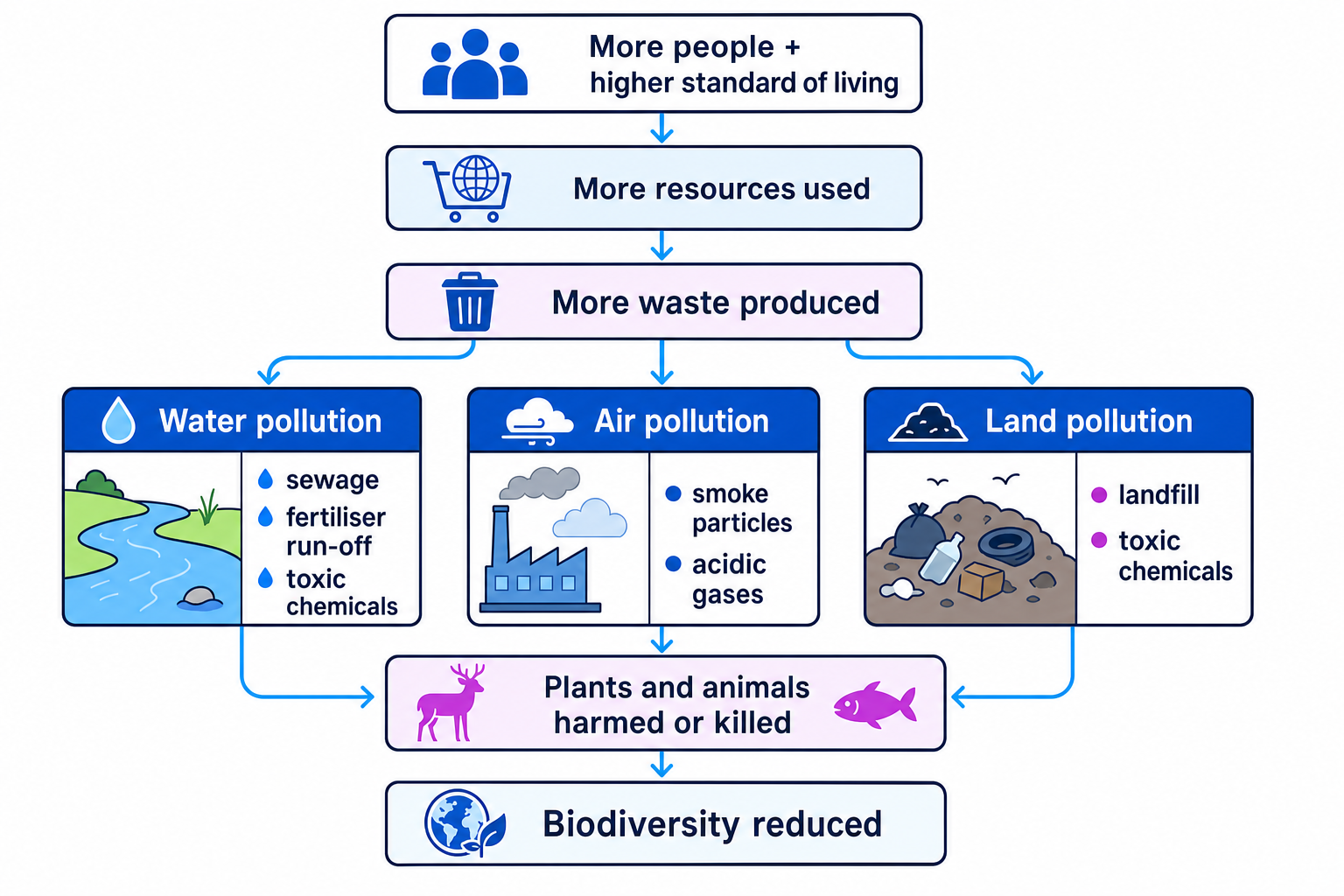
As the human population grows rapidly, more people need food, water, homes, transport, electricity and manufactured goods. If the average standard of living also rises, each person often uses more resources and produces more waste.
Here is the main cause-and-effect chain you need to be able to explain in words.
Key Idea
The big chain
Rapid population growth and higher standards of living increase resource use and waste production. Unless waste and chemical materials are handled properly, more pollution will be caused.
Example
Linking population growth to waste production
A town grows quickly and its residents become wealthier.
- More residents means more total demand for food, water, housing, transport and energy, so more resources are used.
- A higher standard of living may mean people buy more packaged goods, electronics and clothes, so each person may produce more waste.
- The total waste increases because both the number of people and the waste per person may rise. If collection, treatment and disposal do not improve, pollution becomes more likely.
Pollution and pollutants
Pollution is the contamination of the environment with substances that can harm living organisms. The harmful substance is called a pollutant.
Pollution is not just “mess”. It matters because it can kill plants and animals, damage habitats, and reduce the number of different organisms that can survive in an ecosystem.
Definition
Pollution and pollutants
- Pollution is harmful contamination of the environment.
- A pollutant is a substance that causes pollution.
- A toxic chemical is poisonous or damaging to living organisms.
Water pollution
Water pollution happens when harmful substances enter rivers, lakes, seas or groundwater.
The main GCSE examples are:
- Sewage: wastewater containing human waste, household waste and microorganisms.
- Fertilisers: chemicals added to soil to help crops grow, often containing mineral ions such as nitrates.
- Toxic chemicals: poisonous substances from industry, farming or waste disposal.
Sewage can spread disease-causing microorganisms and add material that decomposers break down. Fertilisers can be washed from fields into water by rain; this is called run-off. Toxic chemicals can poison aquatic organisms directly.
Fertiliser run-off and fish deaths
Fertilisers are useful on farmland, but they become a pollutant if they get into waterways in large amounts. Extra mineral ions can cause algae to grow rapidly. If algae block light, underwater plants may die. Decomposers then break down the dead material and use up dissolved oxygen during respiration. Fish and other aquatic animals may die if there is not enough oxygen.
Example
Tracing fertiliser run-off to fish deaths
A farmer applies too much fertiliser before heavy rain, and several days later fish are found dead in a nearby pond.
- The rain washes fertiliser from the field into the pond, adding extra mineral ions to the water.
- Algae grow rapidly and may block light from reaching plants underneath the surface, so some aquatic plants die.
- Decomposers break down dead plants and algae, using dissolved oxygen for respiration.
- With less dissolved oxygen available, fish cannot respire effectively and may die, reducing the biodiversity of the pond.
Common Mistake
Stopping the chain too early
Do not just write “fertiliser kills fish”. A stronger answer explains the sequence: fertiliser enters water, algae increase, plants die, decomposers use oxygen, then animals die.
Air pollution
Air pollution happens when harmful substances enter the atmosphere.
The main GCSE examples are:
- Smoke: tiny particles and gases released when materials burn, such as fuels or waste.
- Acidic gases: gases such as sulfur dioxide and nitrogen oxides, often linked to burning fuels.
Smoke particles can harm animals’ breathing systems and can settle on leaves, reducing how much light reaches them. If less light reaches leaves, photosynthesis may decrease, so plant growth can be affected.
Acidic gases can dissolve in rainwater and form acid rain. Acid rain can damage leaves, change soil conditions, and make lakes or rivers more acidic. This can kill plants and animals that are not adapted to those conditions.
Tip
Air pollution clue words
If a question mentions burning fuels, factories, vehicle exhausts or smoke, think about air pollution. For biology answers, always link the pollutant to harm to living organisms, not just to “dirty air”.
Land pollution
Land pollution happens when harmful waste is left on or in the ground.
The main GCSE examples are:
- Landfill: sites where waste is buried or piled up.
- Toxic chemicals: poisonous substances that may be dumped, spilled or leak into soil.
Definition
Landfill
Landfill is a waste disposal method where rubbish is buried or stored in large sites on land.
Landfill can take up space that could have been used as habitats for wild organisms. Some waste may release chemicals into the soil or water. Toxic chemicals can poison soil organisms, plants and animals. They may also move into water systems, so land pollution can lead to water pollution too.
Common Mistake
Landfill is not just ugly
In exams, “landfill looks bad” is not enough. Link landfill to biological effects: habitat loss, toxic chemicals leaking, organisms being harmed, and biodiversity being reduced.
Example
Identifying water, air and land pollution
A factory dumps chemical waste on bare ground, rain washes some of it into a stream, and waste packaging is burned nearby.
- The chemical waste on the ground is land pollution because toxic chemicals are contaminating the soil.
- The chemicals entering the stream are water pollution because pollutants have been carried into an aquatic habitat.
- Burning the packaging may cause air pollution because smoke particles and acidic gases can be released.
- In each case, the final biological consequence is that plants and animals may be harmed or killed, which can reduce biodiversity.
How pollution reduces biodiversity
Biodiversity is the variety of living organisms in an area. A species is a type of organism; at GCSE, this usually means organisms that can breed together to produce fertile offspring.
Pollution can reduce biodiversity in several connected ways:
- It can kill individual plants and animals.
- It can reduce population sizes, meaning fewer organisms of a species survive.
- It can destroy or damage habitats.
- It can disrupt food chains, because if one organism dies out, other organisms may lose food or shelter.
A polluted river might still contain some living things, but if many sensitive species die and only a few tolerant species remain, biodiversity has decreased.
Key Idea
Biodiversity link
Pollution reduces biodiversity when it lowers the variety or number of organisms able to survive in an ecosystem.
Proper handling reduces pollution
The spec phrase “properly handled” is important. It means waste and chemicals should be treated, contained or disposed of safely.
Examples include:
- Treating sewage before releasing water back into rivers or seas.
- Using fertilisers carefully, so less is washed into waterways.
- Storing toxic chemicals securely to prevent leaks and spills.
- Controlling smoke and acidic gas emissions from burning fuels.
- Reducing landfill by reusing, recycling or using less material in the first place.
You do not need to memorise a huge list of solutions for this sub-topic, but you should understand the principle: preventing pollutants from entering the environment protects organisms and helps maintain biodiversity.
Exam technique
In the exam
- Name the type of pollution: water, air or land.
- Identify the pollutant or source, such as sewage, fertiliser, toxic chemicals, smoke, acidic gases or landfill.
- Link it to a biological effect: organisms are harmed or killed, populations decrease, habitats are damaged, and biodiversity may fall.
Self review
Check yourself
- Why can a higher standard of living lead to more waste being produced?
- Give one source of pollution in water, one in air and one on land.
- Explain how fertiliser run-off could reduce biodiversity in a pond.

Keep learning
Make a free account to read the full revision notes and worked examples.